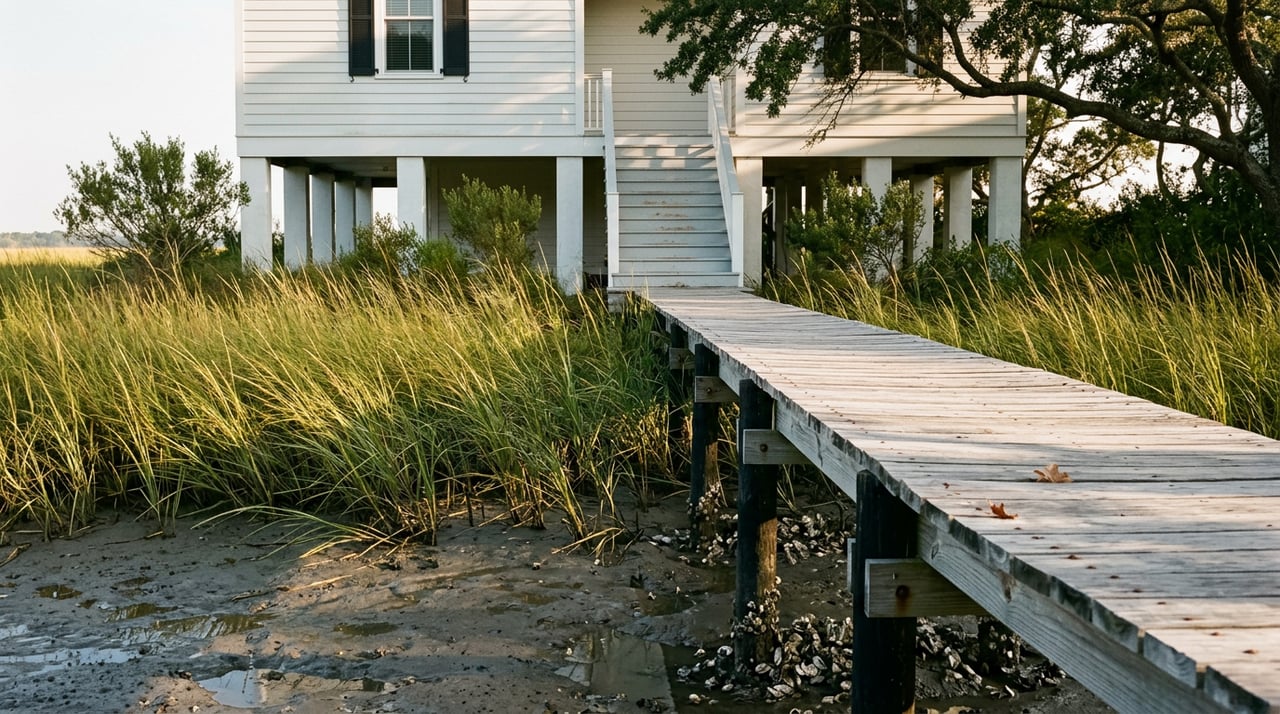
As The Post and Courier reported, Mayor Linda Page once called the shrimp boats tied up on Shem Creek "our skyline." It's the right word if you've walked the boardwalk at sunset while an outrigger swings out over the water and a pelican works the wake behind it. But a skyline that has been losing buildings for decades is a strange thing to keep calling permanent, and that tension is easy to see this month: the docks those boats tie up to got fully rebuilt last summer, for a fleet that keeps getting smaller.
If you live in South Mount Pleasant, you've probably noticed both halves of that sentence without connecting them. The construction fencing came down about a year ago now. The boats you can count from the Coleman Boulevard bridge on any given morning are still fewer than you remember from a decade ago. Here's what's actually going on along the creek right now, and why the town bet real money on a working waterfront that keeps shrinking.
The Docks Got Rebuilt Last August
On August 12, 2025, the Town of Mount Pleasant held a ribbon cutting for a full renovation of the Shem Creek Shrimp Docks. The project widened the boardwalk and pier for better clearance, reinforced the structure against storms, rewired the electrical systems that keep daily operations running, and rebuilt the processing facility the boats depend on to actually sell their catch. Town councilmembers Mike Tinkey, Gary Santos, and Daniel Brownstein were there for the ceremony, alongside Cindy Tarvin of Tarvin Seafood, one of the businesses that has leased dock space here for years.
This wasn't a beautification project aimed at tourists. It was infrastructure spending on ice, fuel, wiring, and a place to weigh and sell shrimp, the unglamorous plumbing that keeps a handful of working boats afloat. The town owns this particular dock outright, having bought it for $4.4 million after a previous owner put it up for sale and a nonprofit land trust scrambled to keep it from being lost to waterfront development. Last summer's renovation is the town following through on that purchase. That's not the behavior of a place hedging its bets on shrimping. It's the behavior of a place that has decided the fleet is worth subsidizing even as it gets smaller.
A Fleet That Has Been Shrinking for Decades
The numbers, pulled from town history and local reporting over the years, tell a consistent story even when the exact counts differ by source and season:
| Period | Approximate working shrimp trawlers | Source |
|---|---|---|
| Historic heyday | About 70 | Town of Mount Pleasant, Shem Creek History |
| 2011 | About 10 | Town of Mount Pleasant, Shem Creek History |
| 2016 | About 6 | Post and Courier editorial, Nov. 2016 |
| 2020 | Roughly 10, split across the creek's last 3 private docks | Post and Courier, Sept. 2020 |
| Late 2023 | 3 to 4 boats working consistently | Post and Courier reporting on the South Carolina Shrimper's Association |
Rocky Magwood, a fourth generation shrimper and president of the South Carolina Shrimper's Association, put it plainly in that 2023 reporting: he sells wild caught shrimp for $7 to $8 a pound, a price that can't compete with imported shrimp flooding the market from overseas. Fewer boats go out because fewer boats can make the math work, not because the creek ran out of shrimp.
That's the piece most visitors miss. Shem Creek's working boats aren't a period backdrop maintained for atmosphere. They're small businesses absorbing a national trade problem, tied to docks the town has now decided are worth rebuilding rather than letting go.
Where the Real Shrimp Still Comes Ashore
If you want shrimp that actually came off one of those boats this week rather than a freezer truck, the creek still has a few reliable places to buy it direct. Tarvin Seafood operates out of the Wando Dock, the same one the town rebuilt. Geechie Seafood sells fresh off the boat most days. Mount Pleasant Seafood has a stand on the park side of the creek.
That distinction matters more than it sounds. Big tourist restaurants along the docks are not required to serve local catch, and plenty don't, because imported shrimp is cheaper. The same economic pressure squeezing the shrimpers on the water is why a menu that says "fresh" doesn't automatically mean it came from Shem Creek. If you're buying for a cookout rather than ordering off a menu, the seafood markets are where the fleet's actual output ends up.
The Birds Get Their Own Closed Season
A short paddle from the shrimp docks, at the mouth of the creek, sits Crab Bank Seabird Sanctuary, a 32 acre island rebuilt in 2021 using sand dredged from the Charleston Harbor deepening project. Right now, in August, you can't land on it. SCDNR closes Crab Bank to all public access from March 15 through October 15 every year to protect nesting birds, and dogs are prohibited on the island year round. It reopens October 16, but only the intertidal zone between the low and high tide lines, through mid March.
The closure isn't bureaucratic overcaution. In 2024, biologists counted nearly 400 Black Skimmer nests on Crab Bank, the largest colony recorded anywhere in South Carolina that year. You can still see the island and its bird traffic from the water. Coastal Expeditions runs guided trips out of Shem Creek that get close without disturbing the colony, which is about as near as anyone is supposed to get this time of year.
The Walk Before Dinner
For most people in South Mount Pleasant, the actual evening routine starts a few blocks away, at the end of Pitt Street. What's there now is a paved remnant of a much older bridge, originally built in the late 1800s as part of a trolley line connecting Mount Pleasant to Sullivan's Island before the Ben Sawyer Bridge made it obsolete. The town turned the surviving half into a public walkway, and it functions today as the neighborhood's default sunset stop: dog walkers, joggers, and a fishing pier at the far end where anglers still pull in flounder, bass, trout, and blue crabs depending on the tide.
From there it's a short drive or a longer walk down to the creek itself, where the restaurant row has grown up around the same waterfront the shrimpers work. Vickery's has been open since 1999. Tavern & Table sits right on the water with a dockside bar built for exactly this kind of evening. Water's Edge and Saltwater Cowboys, the latter open since 2017, round out a stretch where you can watch the boats come in while you eat something that may or may not have come off one of them.
If you're timing a summer evening around live music, know that the Dancing on the Cooper series at Memorial Waterfront Park skips August entirely this year. The last show was Tommy & the Chucktown Players on July 24, and the next one isn't until the Cooper River Band on September 11. The Tuesday Farmers Market, on the other hand, keeps running through the end of September, so that part of the summer calendar still has a few more weeks left.
What the Investment Actually Says
None of this adds up to a neighborhood in decline. It adds up to a neighborhood that has decided its working waterfront is worth the cost of keeping, even as the economics of shrimping keep making that harder. The docks are newer and more storm resilient than they've been in decades. The fleet tying up to them is smaller than it has ever been. Both things are true at once, and the second one is exactly why the first one happened.
That's the version of Shem Creek that doesn't show up in a restaurant guide: not a fixed postcard, but a working system that requires continual, deliberate reinvestment to survive at all. The boats you see this month are there because a town council voted to spend money keeping them there, not because the creek runs on autopilot.
If you already live along this stretch of Mount Pleasant, you've been watching this story unfold for years without necessarily having the numbers behind it. If you're the kind of person who wants that level of detail before you make any decision about a place, that's the same approach Robertson Allen brings to every property conversation in this part of the Lowcountry. Reach out to schedule a private market consultation whenever you're ready to talk specifics.
This article is general information, not legal, tax or financial advice. Consult a qualified professional about your situation.