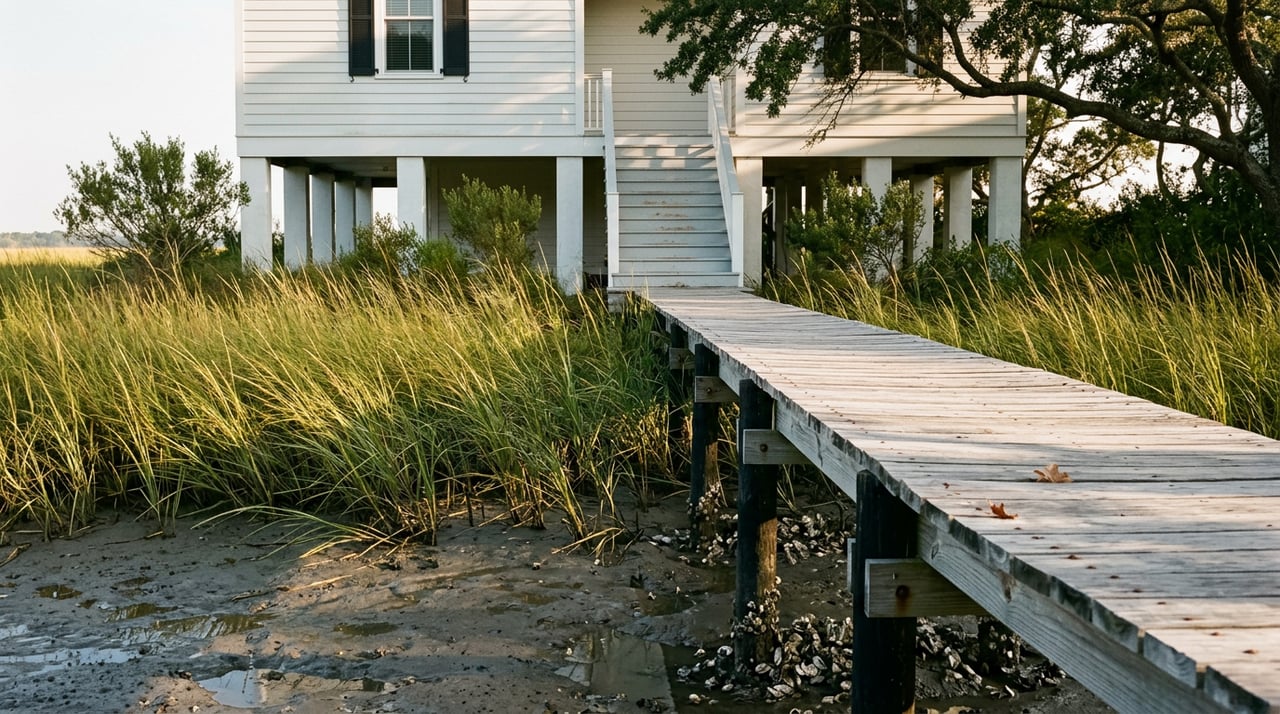
About six weeks from today, on September 30, 2026, the federal government's authority to sell and renew flood insurance expires unless Congress acts again. That isn't a policy footnote for someone browsing headlines. It's a live variable for anyone with a signed contract on a raised cottage near Pitt Street or a marsh-front lot off Venning Street closing this fall, because most of Old Village sits inside FEMA's Zone AE, and a federally backed mortgage there cannot close without an active flood policy in hand.
Here's what almost every buyer gets wrong before that deadline even matters: the letters on the flood map, AE, VE, X, tell you almost nothing about what you'll actually pay. That hasn't been true since FEMA rewrote its pricing model. Two houses on the same Old Village block, in the identical zone, can carry premiums thousands of dollars apart, and the number that separates them isn't printed on any map at all.
A Deadline the Contract Doesn't Mention
This isn't the first time the clock has run out this cycle. The National Flood Insurance Program already lapsed for 43 days in late 2025, and Congress let a shorter lapse happen at the end of January 2026 before signing the extension that runs through September 30 of this year. Since the end of fiscal year 2017, Congress has kept the program alive through 35 separate short-term extensions rather than a single long-term reauthorization.
That history matters for what happens next, because a lapse doesn't work the way most buyers assume. If authorization expires and isn't renewed on time, FEMA loses the ability to issue new flood policies or process renewals. Policies already in force, including one a seller already holds on an Old Village home, keep running until the end of their term, with a 30-day grace period built in. Claims still get paid as funds allow. And under National Association of Realtors guidance, an insurer can assign a seller's existing NFIP policy to a buyer at closing simply by substituting names, so a buyer inheriting an active policy may never need to open a new one. The real exposure sits with a first-time buyer who has no existing policy to inherit and needs to bind coverage for the first time during a gap. Federally regulated lenders have generally suspended the mandatory purchase requirement during past lapses, but that call belongs to each lender, not to any single rulebook.
For an Old Village buyer under contract this fall, that argues for one unglamorous move: get the flood quote locked and the policy issued well before closing week, not during it. Nationally, the Realtors' estimate puts the stakes at roughly 1,300 home sales a day, about 40,000 closings a month, largely because a mortgage in a Special Flood Hazard Area simply cannot fund without that coverage in place.
The Number That Actually Sets the Premium
Assume the deadline passes cleanly, the way it has every time so far. The zone letter still won't tell a buyer what they'll pay. Since FEMA introduced Risk Rating 2.0, the agency prices each policy against the specific property, its elevation, distance to water, construction type, and rebuild cost, rather than assigning one flat rate to everyone inside a zone boundary. Current 2026 pricing for South Carolina coastal properties runs roughly like this:
| Flood Zone | Typical Annual Premium (2026) | Required for a Federally Backed Mortgage |
|---|---|---|
| X, unshaded, low risk | $400 to $800 | No |
| AE, mapped base flood elevation | $1,500 to $4,500 | Yes |
| VE / Coastal A, coastal high hazard | $1,500 to $4,500 or higher | Yes |
Two houses on the same Old Village street, both mapped AE, can land at very different points in that range depending on how each one was actually built and sited, not on which side of the zone line it falls.
The One-Way Bet Most Owners Skip
An elevation certificate, a survey a licensed professional prepares showing a structure's lowest floor relative to FEMA's Base Flood Elevation, is no longer required to get an NFIP quote under Risk Rating 2.0. That's exactly why it's worth getting anyway. If a new certificate shows a home sits higher than FEMA's default modeling assumed, the agency recalculates the premium downward and prorates a refund back to the policy's effective date. If the certificate comes back worse than expected, the existing rate simply stays put. There is no penalty for asking the question, only a $300 to $600 survey fee and roughly a week's wait for the answer. For a raised Old Village cottage that's been elevated or added onto over decades, that gap between the assumed number and the earned one only opens in the owner's favor.
Mount Pleasant compounds that advantage before an owner even orders a survey. The town participates in FEMA's Community Rating System, which credits communities for exceeding minimum floodplain management standards, and Mount Pleasant currently holds a Class 6 rating, worth a 20 percent discount on NFIP premiums for every policyholder in town, regardless of which zone a specific home sits in.
Where the District Line Actually Falls
The geography here matters in a way a flood map alone doesn't show. Old Village's local historic district, established by the town in 1979 and administered by the Old Village Historic District Commission, runs a 37-block area bounded by Shem Creek on the north, excluding the boatyard, Whilden Street on the east, the old bridge and marshland on the south, and Charleston Harbor on the west. Much of that ground sits inside the Special Flood Hazard Area, which is why the town's building rules changed in 2021: new flood maps effective January 29 of that year raised Mount Pleasant's Design Flood Elevation from one foot above base flood elevation to two, added a Coastal A Zone regulated the same as VE, and shortened the window for cumulative substantial improvement work from ten years to five.
A buyer comparing a harbor-facing lot to one a few blocks inland along Whilden Street is comparing two different regulatory postures, not just two different views.
The zone on the map sets the requirement. The elevation on the survey sets the price.
What This Means for a Closing in the Next Six Weeks
For anyone with a contract on an Old Village or Coleman Boulevard-adjacent property closing before or shortly after September 30, a few moves belong in due diligence, not in closing week itself.
- Order the elevation certificate early, or request the one the town already has on file before paying for a new survey.
- Ask the seller's insurer directly whether the existing policy can be assigned at closing rather than replaced, especially if the closing date lands near a possible lapse window.
- Get a private flood insurance quote alongside the NFIP number. Private coverage doesn't depend on NFIP's authorization and stays available if Congress lets the deadline pass again.
- Confirm Mount Pleasant's Community Rating System discount is reflected in any quote before comparing it against a number from another municipality.
None of that changes whether a given lot floods. It changes whether the number on the listing sheet is the number a buyer actually gets asked to pay, and whether a signed contract survives a deadline that has already come and gone twice this cycle with no advance warning to anyone holding a purchase agreement.
A Few Questions Worth Asking Before You Sign
Does every Old Village home need flood insurance? Only if it's mapped inside a Special Flood Hazard Area, Zone AE or VE, and financed with a federally backed mortgage. Homes in Zone X aren't required to carry it, though many owners near tidal water choose to anyway.
What happens if the NFIP lapses right as I'm supposed to close? No new or renewal policies get issued during the lapse itself. An existing seller's policy can typically be assigned to a buyer without a coverage gap. A first-time buyer with no existing policy to inherit carries the most exposure to delay.
Can I still close in Zone AE if the program lapses? Some lenders continue funding without a bound NFIP policy during a lapse, and private flood insurance remains available regardless of NFIP's status. Confirm your specific lender's position early rather than assuming either way.
If you're weighing a purchase or sale in Old Village and want the flood math settled before you write an offer rather than after, Robertson Allen and the team can walk through the elevation, zone, and timing specifics for a particular address. Schedule a private market consultation.